

How to choose a chiropodist near me in London: what to check before booking
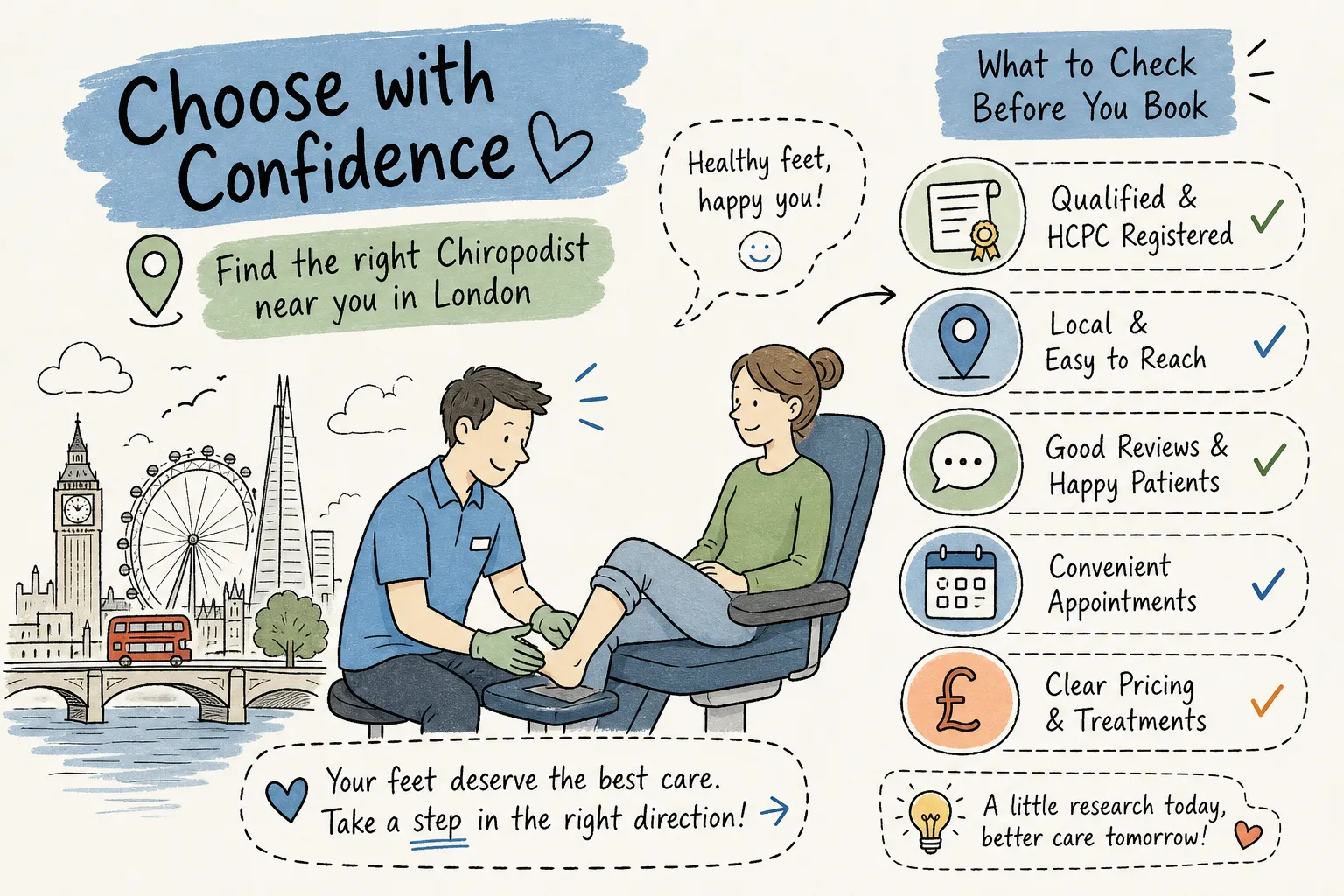
You type "chiropodist near me" into Google and get back a wall of sponsored listings, national directories, one-star reviews, and clinic names you've never heard of. Some look professional. Some look as though they were last updated in 2014. Somewhere in that list is the right person for your feet, but there's no obvious way to tell who that is from a search result alone.
Not every clinic that appears is equally qualified, equally equipped, or even legally permitted to use the title "chiropodist" or "podiatrist." The good news is that narrowing the list down to someone genuinely worth booking takes less effort than most people think. You just need to know what to check. This piece covers credential verification, NHS versus private options, what a well-equipped clinic actually offers, and how to book with confidence rather than hope.
Finding a chiropodist near me in London: checking credentials first
Why the HCPC register is the only check that matters
"Chiropodist" and "podiatrist" are legally protected titles in the UK. A person cannot lawfully use either unless they are currently registered with the Health and Care Professions Council. Using either title without registration is a criminal offence carrying a fine of up to £5,000. None of these — a Google listing, a clinic website, or a five-star rating — constitutes proof of registration.
The HCPC's online register is publicly searchable, free to use, and takes about two minutes to check. Search by the practitioner's surname and select "chiropodists/podiatrists" as the profession, or enter their registration number directly. A valid result will show their name, registration status (it should say "Registered"), the current registration period, and any cautions, conditions, or restrictions on their practice. If a practitioner won't give you their HCPC number when asked, that tells you something important.
What HCPC registration actually guarantees
Registration confirms that a practitioner completed an approved training programme, meets the HCPC's standards of proficiency, undertakes ongoing continuing professional development, and is subject to a formal fitness-to-practise process if something goes wrong. That is a meaningful baseline, far more than an unregulated foot-care technician at a nail bar can offer.
Registration does not guarantee specialist expertise in every condition, or a particular treatment outcome. It is the floor, not the ceiling. Once you've confirmed someone is registered, you still need to ask whether they have experience with your specific problem and whether the clinic has the right equipment to treat it.
Useful directories for finding local candidates
The Royal College of Podiatry's "Find a Podiatrist" tool and the NHS service finder are good starting points for building a shortlist when searching for a podiatrist near me or a podiatry clinic near me. Commercial directories like FootcareUK and Bark can surface additional names, though both mix HCPC-registered practitioners with unregistered foot-health workers. Age UK local branches sometimes publish regional lists, but these can be out of date. Every practitioner you find through any directory still needs to be checked independently on the HCPC register before you book. Treat all directories as a starting point only.
Choosing a chiropodist near me: NHS or private?
Who actually qualifies for free NHS foot care
NHS podiatry is allocated on clinical risk, not on age or difficulty reaching your feet. Eligibility criteria are set locally by each Integrated Care Board, so there is no single national rule, but the common qualifying conditions include: diabetes with foot complications or elevated risk, peripheral arterial or vascular disease, neurological conditions with reduced sensation, inflammatory arthritis affecting the feet, immunosuppression or chemotherapy, and active ulcers or wounds.
Routine nail cutting, minor corns, and general foot maintenance are typically not NHS-funded, even for older patients who genuinely struggle to care for themselves. Some ICB areas accept self-referrals; others require a GP to refer you first. If you are unsure whether you qualify, your GP is the right first point of contact.
Where private chiropody near me fills the gap
Private clinics treat the large majority of foot problems that don't meet NHS thresholds but are still genuinely painful and limiting. Corns, calluses, thickened nails, stubborn verrucas, ingrown toenails, fungal infections, and biomechanical pain all fall into this category. Access is faster, appointment times are typically longer, and the range of available treatments is considerably broader.
For context on costs in London in 2026: routine appointments generally run £60 to £100, an initial consultation with treatment sits around £75 to £150, and a biomechanical or gait assessment is typically £95 to £225. Custom-made orthotics commonly run £280 to £550 per pair, depending on the clinic and whether the assessment is included. These figures vary by location and practitioner seniority, so always ask for a full cost breakdown before committing.
When private care is the smarter route even for complex conditions
Some of the most effective treatments for persistent or chronic foot conditions are simply not available on the NHS. Extracorporeal Shockwave Therapy for plantar fasciitis and Achilles tendinopathy, medical-grade laser for fungal nail infections, and Swift microwave technology for verruca removal are all treatments that typically require a private specialist with the right equipment. If a condition has already gone through the standard GP cycle without resolving, a well-equipped private clinic is often the more direct path to recovery.
What a well-equipped London foot clinic should offer
The treatments worth asking about before booking
A strong podiatry clinic goes well beyond basic nail care. The treatments that signal genuine clinical depth include Extracorporeal Shockwave Therapy for chronic tendon and heel conditions, medical-grade laser for persistent fungal nail infections that haven't responded to topical or oral antifungals, Swift microwave technology for verruca removal, and custom-made orthotics developed following gait analysis. Nail surgery for ingrown toenail cases that haven't responded to conservative care should also be on offer.
Clinical evidence backs these treatments for the right conditions. Meta-analyses support ESWT for chronic plantar fasciitis and Achilles tendinopathy, with meaningful pain reduction compared to conservative care. Swift microwave therapy achieves clearance rates of around 86% among patients completing a full course of treatment, typically across two to four sessions, which compares favourably to cryotherapy's more variable results over six or more rounds.
Flawless Feet Podiatry & Laser Clinic: a London example
Flawless Feet Podiatry & Laser Clinic was founded in 2006 by HCPC-registered podiatrists Hiren and Reena Patel. With over 20 years of clinical experience and a 4.9-star patient rating, the clinic operates three London locations: Sydenham, Covent Garden, and Croydon. All three are open six days a week, including Saturdays, which matters considerably for anyone trying to fit specialist care around a working week.
The clinic offers the full range of treatments described above: Shockwave Therapy, laser fungal nail treatment, Swift verruca removal, custom orthotics with gait analysis, nail surgery, and medical pedicures performed by qualified podiatrists. No GP referral is required to book. Three locations across south and central London make access genuinely practical for a wide catchment of residents.
Location, hours, and accessibility: the practical checklist
Beyond the clinical offering, ask a few practical questions before confirming a clinic. What are the opening hours, and is Saturday available? Is the clinic accessible by public transport, and is there step-free access? A clinic that ticks every clinical box but requires an inconvenient journey and only offers weekday morning slots will create its own barrier to consistent care. These details matter as much as the treatment menu when you're committing to an ongoing course of appointments.
Foot problems that need a specialist rather than a GP
Conditions where specialist treatment makes a measurable difference
Plantar fasciitis, Achilles tendinopathy, Morton's neuroma, and sports-related lower limb injuries are all conditions where a podiatrist's expertise and clinical equipment outperform the GP referral pathway. A GP is generally limited to advice and onward referral. A podiatrist can assess, diagnose, and begin treatment in the same appointment using gait analysis, biomechanical assessment, and hands-on clinical tools, shortening the time between onset and effective management considerably.
Persistent nail and skin problems that have already beaten pharmacy treatments
Fungal nail infections that haven't cleared after a full course of topical or oral antifungals, verrucas that have survived repeated cryotherapy or salicylic acid, and recurring ingrown toenails are all cases where specialist clinical intervention is the right call; another round of off-the-shelf products is not. A practitioner with access to laser technology or Swift microwave therapy changes the outcome calculus entirely. These are not luxury treatments; for conditions that have already failed standard routes, they are the appropriate next step.
Diabetic and circulation-related foot concerns
People with diabetes or vascular conditions need an HCPC-registered podiatrist, not a nail bar or beauty salon. Reduced sensation, slower wound healing, and elevated infection risk mean that even routine nail care carries genuine clinical stakes. Registered practitioners are trained to identify early warning signs of ulceration, ischaemia, and infection during what looks like a routine appointment. That clinical eye is not something training in nail aesthetics provides.
What to expect at your first chiropody appointment
Before you arrive: what to bring and how to prepare
Bring a list of any relevant medical conditions and current medications. Bring your usual footwear, including work shoes and trainers, not just the pair that felt comfortable this morning. If you have any previous imaging, podiatry reports, or orthotics from a prior practitioner, bring those too. Wearing the shoes you spend most of your time in gives the practitioner the most accurate picture of how your feet are actually being loaded each day.
The assessment and what gets decided
A first appointment will typically include a medical history review, a visual and physical assessment of your feet, and a conversation about your symptoms, activity levels, and lifestyle. For biomechanical concerns, gait analysis will usually be part of this session. By the end, the practitioner will outline a treatment plan with expected timelines, session numbers, and total costs. You are not committing to anything at this stage; you are gathering the information you need to make a confident decision.
Follow-up and ongoing care
Many conditions resolve well within a short course of treatment. Others, like orthotics management or chronic tendinopathy, require staged and ongoing care. A good clinic will be transparent about this from the first appointment, giving you a realistic picture of what the commitment looks like in both time and cost. If a clinic can't give you a clear treatment plan after assessing you, that's worth noting before you rebook.
Practical steps to book and what to ask when you call
Questions worth asking before committing to an appointment
When you contact a clinic, ask four things directly. Is the practitioner HCPC-registered, and can they give you their registration number? Do they have specific experience treating your condition? What does the first appointment include, and what is the total cost? Are any follow-up appointments part of the treatment plan, and if so, how many and at what cost? These questions take two minutes to ask and save a lot of uncertainty later.
Home visits and accessibility for housebound patients
Many private chiropodists offer domiciliary appointments for older or housebound patients. These are typically available within a defined postcode area on weekday daytimes, and they carry a travel surcharge on top of the standard treatment fee. When enquiring, confirm the service area, the total cost including travel, and whether the practitioner is equipped and experienced in managing diabetes, wound care, or reduced sensation. These are not details to leave vague.
Booking with Flawless Feet Podiatry & Laser Clinic
Flawless Feet accepts bookings at its Sydenham, Covent Garden, and Croydon clinics without a GP referral. Saturday appointments are available at all three locations. As noted above, the clinic brings over 20 years of clinical experience, full HCPC registration, and a 4.9-star patient rating, making it a practical option for London residents who want qualified clinical care without a long wait or a complicated referral process. Get in touch with the team directly to book a consultation by phone, or book online through the clinic's website.
The short version, if you take nothing else from this
Check the HCPC register before you book anyone. Match the clinic's treatment list to your specific foot problem, not just to their location. Book a first appointment directly, without waiting for your GP to move things along.
Finding the right chiropodist near me, or near you, in London is genuinely achievable in an afternoon when you know what to look for. The right practitioner is closer than most people expect, and most conditions respond far better to early specialist input than to months of hoping they improve on their own.
Most conditions respond better to early intervention than to prolonged rest and repeated over-the-counter remedies. If you've been managing with the pain, masking it, or waiting for it to sort itself out, booking a first appointment with a qualified chiropodist near me or a local podiatrist near me is the most practical next step you can take this week.
FAQs: chiropodist near me
What is the difference between a chiropodist and a podiatrist?
The terms are used interchangeably in the UK. Both are legally protected titles regulated by the HCPC. Historically, "chiropodist" was the older British term; "podiatrist" has become more common in clinical and academic settings, but registered practitioners may use either title.
How do I know if a chiropodist near me is properly qualified?
Search the HCPC online register by name or registration number. This is the definitive check. A five-star Google rating or a professional-looking website does not confirm HCPC registration.
Can I book a chiropodist near me without a GP referral?
Yes, for private clinics. Most private podiatry clinics in London accept direct bookings without any referral. NHS podiatry usually requires a GP referral, and eligibility is based on clinical need rather than patient preference.
How much does a chiropodist near me in London cost?
Routine private appointments in London typically range from £60 to £100. Initial consultations with treatment run from around £75 to £150. Specialist treatments such as Shockwave Therapy, laser fungal nail treatment, and custom orthotics carry higher costs; always ask for a full fee breakdown before booking.